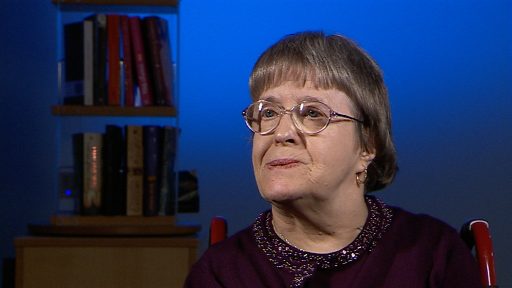
Joan Ross, contributed to the Speaking for Ourselves oral history of people with cerebral palsy at the British Library Sound Archive. She died in January 2017. Using extracts from her interview, we celebrate her life.
Going to school
“[Alan’s mother] took it for granted that I was entitled to education like everyone else… She wanted me to be able to read so that I could read to myself and so on. She saved for me to go to a little private school very near where we lived, but they refused to have me, so she tried the local infants school that was all on one level, and they were very reluctant. The headmistress did want to take me, she was willing to have me, but the education authority weren’t happy about me going and I didn’t have to go to school, it wasn’t compulsory. So my mum decided to go to the education offices every day to ask them when they were going to find a place for me at this school she had in mind, and one day when she went she heard one of them say, ‘That Ross woman is here again’, and so she said, ‘Yes. And I’ll be here again tomorrow until you offer me a place for my daughter at school’. So they did agree to place me in the school that she’d chosen, on condition that she came there and took me to the toilet twice a day, maybe more, fed me at lunch time; the teachers would teach me but nothing else, no personal care. But she was willing to do that, and I was very happy there.”
Brownies and Guides
“We had a uniform which made me feel one of them. Our school didn’t have a uniform, so I enjoyed having an identity. I enjoyed the badge-work in Guides because that was way of proving myself.
We didn’t really take a lot of exams and that at school, so this was a way of stretching myself and proving myself. The Guides, once they realised that I was just the same as them, except I was in a wheelchair, accepted me and I really felt one of them.
After I left school. I was still in the Rangers, the senior part of the
Guides, and one of the things the Rangers did was help with Cubs and Brownies, so I was delighted when I was asked if I would like to help with a Brownie pack, and I did that for about a year, or maybe longer. And then my own church Brownie pack was without a leader, and I longed to offer to take over the pack, but I didn’t want to do that because I didn’t want to be turned down. So I was delighted when I was approached to actually do that, and I did it for 15 years. And it really compensated for not working because it gave me an important job to do which took a lot of time but was very worthwhile.”
Learning to drive
“I was able to get around by bus, but it was very difficult and very tiring, and I used to get a lot of pain sometimes. So I mean a car was a big step forward and gave me a lot more freedom and enabled me to go on holiday myself.
I had a friend that was willing to come with me who was also disabled – Janet – and we had several holidays in Kent. We had invalid cars to begin with, so we went in them.
It’s a three-wheeled car with only one seat for one person. It was made of fibreglass. My first invalid car was electric because I couldn’t manage gears, and would only do 10 miles an hour, but it was on the road not on the pavement like the scooters like you see now, so I was very limited to where I could go on a charge battery. But a few years later I got a petrol invalid car which looked the same as the electric car but was able to do 50 miles an hour, and that’s when I started to go on holiday because my friend Janet had an invalid car as well, so we used to go together.”
Read Joan’s autobiography, I Can’t Walk, But I Can Crawl
 Alex White writes
Leave a comment