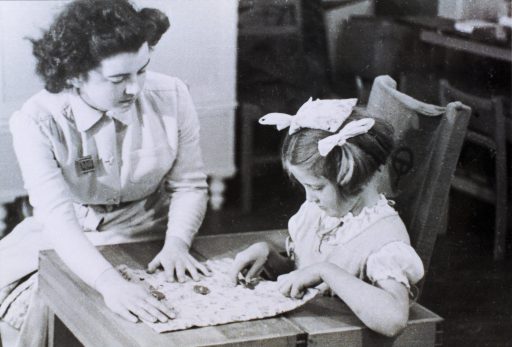
Valerie Lang MBE found the medical label of cerebral palsy (CP) followed her into her education.
“The diagnosis was not helpful. They just followed the book, which said cerebral palsy included what was then mental handicap, and therefore they were constantly telling my parents I was ineducable.”
The doctors’ pessimistic prognosis about cerebral palsy made it difficult for parents to find a suitable education for their children.
Battling with the education authorities
Barry Morgan’s parents had a legal battle with the authorities before he was able to go to his local school with his brother.
“The authorities wanted to send me away to a residential school because of my physical disability. And my dad said, ‘No way are you taking my son off me… He’s got a brother. He can go to school with his brother. He can sit by his brother, and he can learn to read and write with his brother.’ My father said, ‘I am not going to have my son put away in an institution,’ and he never did. He told them that I could go to school, with my younger brother, and that would be acceptable to him and if I needed some help, my younger brother could help me out…I was very lucky that, he found a headmaster that was prepared to give me the opportunity of going to a normal school.”
Joan Ross’s mother had a constant battle getting a school to take her.
“She took it for granted that I was entitled to education like everyone else… She wanted me to be able to read so that I could read to myself and so on. She saved for me to go to a little private school very near where we lived, but they refused to have me. So she tried the local infants school that was all on 1 level, and they were very reluctant.
“The headmistress did want to take me, she was willing to have me, but the education authority weren’t happy about me going and I didn’t have to go to school. It wasn’t compulsory. So my mum decided to go to the education offices every day to ask them when they were going to find a place for me at this school she had in mind, and one day when she went she heard one of them say, ‘That Ross woman is here again’, and so she said, ‘Yes. And I’ll be here again tomorrow until you offer me a place for my daughter at school’.
“So they did agree to place me in the school that she’d chosen on condition that she came there and took me to the toilet twice a day, maybe more, fed me at lunch time. The teachers would teach me but nothing else, no personal care. But she was willing to do that, and I was very happy there.”
No extra support at school
In the 1950s, there was no extra support for disabled children in mainstream school. Anne Pridmore remembered the extra efforts that her mother had to make:
“She fought very hard for me to go to what we used to call ‘mainstream school’ in those days. When I was 5, she had 10 trips to school in order that I could go to the mainstream school, cos she’d take me to school, then come back, then she had to go at the tea break, and then at lunchtime and back, tea break in the afternoon, and pick me up, because they wouldn’t allow me to be in the playground on my own because of course there was no support in these days.”
Being carried to school
Alan Counsell also went to his local school, thanks to the moral (and physical) support of his family.
“The headmistress at the school had refused to take me. And my Grandmother was formidable, absolutely formidable, where I was concerned. And through that visit I got to go to school, with the rest of the family.”
But Alan’s education came at some cost to his older brother:
“My brother, can you imagine this? I thought nothing of it until I got older. I was 5. My brother was about 9. He used to carry me on his back to school in the morning. Came for me during playtime. That means he carried me around because I couldn’t walk; carried me home at lunchtime; carried me back to school after lunch and carried me back after school in the afternoon. That’s a bit much, you know, for a 9-year-old to carry a 5-year-old, and he did that every day and never complained. I didn’t learn to walk until I was 10 or 11.”
Alan’s grandmother also supported him:
“Grandmother was a very unusual woman. She used to come to school. I had difficulty, eating and drinking etc, etc, and she would appear at the school every day, with a big towel and a bottle of milk, with a teat on it, and she used to give me this bottle of milk through the school railings, every day, and my brother, Joe, would help her. He would be on the school side of the building, and he would tie this big towel around me, so I didn’t make a mess, and Grandma would pour the bottle through the railings. Yeah, because she didn’t want me to miss out on any nourishment.”
In 1969, Alan became a teacher at Meldreth Manor School, near Royston. He went on to become a published author and educational trainer.
Getting to and from school was only the start. Sometimes the physical barriers, however onerous, were easier to overcome than the emotional ones.
Pat Entwistle MBE was the only disabled child in his school:
“They didn’t know what to do with me at all… There was 250 children, and I was the only disabled child there. I used to try and walk, and the other kids used to push me over. They used to come and pat you on the head like that, and it’s a wonder my head isn’t flat!”
Name calling
Name calling was a problem for many. Antonia Lister-Kaye was the target of abuse from local children:
“When I went out on my bicycle, they used to cry out, ‘Here comes Useless Eustace!’ and, you know, be horrible, and I used to go back and cry, cry and cry, and think, ‘Why? Why am I like this? Why will nobody tell me why I’m like this? Why will nobody talk about it?”
Barry Morgan recalled some of the names he was called:
“They could call you ‘cripple’. They could call you ‘zombie’, you know and things like this.”
Making friends could also be a problem. Dr Lin Berwick MBE said:
“You would have thought that I had a contagious disease. You could actually hear parents saying to their children, ‘No, you don’t want to be friends with her, because she will restrict you. You need friends of your own. She’s not very mobile. You don’t want to get lumbered with a disabled friend.’”
Desmond Cox found that questions from other children made him realise he was different:
“When I used to talk to kids, who lived at my first, near my first school in Southport, boarding one, and they used to come round and talk to us over the fence, like at the back of the school…
“And one day, one of them actually said to me, ‘Don’t you walk funny? Isn’t though the way you move a bit odd?’
“And after a while, it got to me, because back then, earlier, nobody had, they’d made it so nice that you’re not aware of your disability at first, ‘cos my first school, it was all kinds of disabled children, all put together in one school, back then: all together, all kinds.”
Bullying
Bullying was not only in mainstream schools. Other disabled children could also be cruel, as Dr Lin Berwick MBE found when she lost her sight:
“Well, the early years at the school for physically handicapped were very tough. When I went blind, the kids at the school were really nasty and I went through some horrible jeering and bullying, and people laughing at me because I walked into things.
“I went to walk through a door that had glass panels and, because I could see the light through I thought the door was open, and of course it wasn’t, and I sort of smashed my face, and then I walked into a brick wall and things like that, and hit my face again and I had tripod sticks poked into, and walking sticks poked into my face and handfuls of mud rubbed into my face, and kids saying “Can you see that, then, Berwick?”, and it was horrendous at a time when you’re really frightened, because you’ve now suddenly got a new disability which you don’t know how to handle.”
Frustrated at school, Antonia Lister-Kaye rebelled against authority and was eventually expelled:
“I was very quick at school, and very slow in almost every other aspect. I read quite a lot of the classics before I was 11 or 12, and I even liked comics, The Beano. Desperate Dan!
“But I had difficulty with writing, and it was very frustrating, because I wanted to write. I had to write standing up, and I used to have a thick pen, because they were easier, but people didn’t go out of the way to make it easy for me. They’d prefer not to recognise it really.
“I was always very sociable and gregarious, and I don’t think I let my disability get in the way all that much when I was a child. And then I went to boarding school when my mother became very ill and went to the sanatorium. I went to a boarding school for a year, and I hated that. The head teacher had been a friend of my mother. She was horrible to me, and I used to do terrible things like walking round the 18-inch ledge at the top of the Queen Anne building, and I got caught.
“We used to sneak into the teachers’ bedrooms and try on their bras, but we did this once too often, and the gardener saw me, and I was expelled.”
Valerie Lang MBE’s parents were told their child should be sent to a long-stay ‘subnormality’ hospital. Valerie’s mother refused, teaching Valerie to feed herself, talk at the age of 3 and walk at the age of 6.
St Margaret’s School, Croydon
In 1946, Valerie’s grandfather heard of St Margaret’s near Croydon, a residential school specialising in cerebral palsy. Fees at St Margaret’s were equivalent to Eton but, under the 1944 Education Act, Cheshire County Council agreed to fund Valerie’s education.
Also at the same school were parents Alex Moira, Ian Dawson-Shepherd and Eric Hodgson, who, with social worker Jean Garwood, created the organisation now known as Scope in 1952.
The reason they did so was because there was no equivalent secondary school for their daughters to go. They decided to raise £1 million to build a school.
Almost immediately the fledgling charity had waiting lists of children previously regarded by the education authorities as ‘ineducable’.
Valerie remembers life at St Margaret’s:
“We all had cerebral palsy. It was a tiny school really. We had 3 classes… We had an hour’s therapy a day, taken out of this school day, so you had 20 minutes’ physio, 20 minutes’ occupational therapy and 20 minutes’ speech therapy: all exceedingly necessary, but, somewhat disruptive to the education process.”
Although she had academic ability, Valerie struggled with the physical aspects of exams:
“It was difficult because writing for me really was never easy, and it was physically a great effort. My writing was not easy to read. It was slow…
“I was always given extra time during exams, but for some reason Mr Williams didn’t ask for any concessions or maybe he couldn’t get them. Maybe I’m doing him an injustice, but when we took the O-levels, I was given no extra time for my papers. I had to take them under entirely normal conditions, and I just couldn’t do it.
“Although I was very good at English, and I knew my books backwards (the literature books), I failed both my English Language and Literature, because I only completed the first 2 out of the required 6 questions. I physically couldn’t fit any more into the time.
“When it came to History, which I think was the third paper, I decided this was not working, so I wrote my History answers in note form, and I passed that one.”
Valerie Lang MBE went on to get a degree.
The quotes in this blog come from Speaking for Ourselves, the oral history of people with cerebral palsy.
 Alex White writes
Leave a comment